
TAIZE COMMUNITY
The Taizé
Community is an ecumenical monastic order in Taizé, Saône-et-Loire, Burgundy,
France. It is composed of more than one hundred brothers, from Protestant and
Catholic traditions, who originate from about thirty countries across the
world. It was founded in 1940 by Brother Roger Schutz, a Protestant. Guidelines
for the community’s life are contained in The Rule of Taizé.written by
Brother Roger and first published in French in 1954.The community
has become one of the world's most important sites of Christian pilgrimage.
Over 100,000 young people from around the world make pilgrimages to Taizé each
year for prayer, Bible study, sharing, and communal work. Through the
community's ecumenical outlook, they are encouraged to live in the spirit of kindness,
simplicity and reconciliation.
Brother Roger,
founder of the Taizé Community, shown at prayer in 2003.He pondered what it
really meant to live a life according to the Scriptures and began a quest for a
different expression of the Christian life. A year after this decision Roger
reflected, “‘The defeat of France awoke powerful sympathy. If a house could be
found there, of the kind I had dreamed of, it would offer a possible way of
assisting some of those most discouraged, those deprived of a livelihood; and
it could become a place of silence and work.’ Because his Swiss homeland was
neutral and thus less affected by the war, he felt as if France would be ideal
for his vision. For Roger, France was a “land of poverty, a land of wartime
suffering, but a land of inner freedom.” He eventually settled in Taizé, which
was a small desolate village just north of Cluny, the site of a historically
influential Christian monastic foundation.
 In September
1940, Roger purchased a small house that would eventually become the home of
the Taizé community. Only miles south of the separation line that divided a
war-torn country in half, Roger’s home became a sanctuary to countless war
refugees seeking shelter. On November 11, 1942, the Gestapo occupied Roger’s
house while he was in Switzerland collecting funds to aid in his refuge
ministry. Roger was not able to return to his home in Taizé until the autumn of
1944, when France was liberated.
In September
1940, Roger purchased a small house that would eventually become the home of
the Taizé community. Only miles south of the separation line that divided a
war-torn country in half, Roger’s home became a sanctuary to countless war
refugees seeking shelter. On November 11, 1942, the Gestapo occupied Roger’s
house while he was in Switzerland collecting funds to aid in his refuge
ministry. Roger was not able to return to his home in Taizé until the autumn of
1944, when France was liberated.
In 1941, Roger
had published a few small brochures outlining several facets of a
Christ-centred communal life together. These brochures prompted two young men
to apply, soon followed by a third. They all lived in Switzerland in a flat
owned by Roger’s family until after the war when they began a new life together
in the French countryside. Over the next few years several other men would join
the community. On Easter day 1949, seven brothers committed themselves. to a
life following Christ in simplicity, celibacy and community.In 1969 a young
Belgian doctor became the first Catholic brother to pledge his life to the
community in Taizé. More brothers from Reformed, Anglican and Roman Catholic
backgrounds joined the community. Soon the Brothers of Taizé were making trips
to take aid to people in both rural and urban areas. They began forming
“fraternities” of brothers in other cities that sought to be “signs of the
presence of Christ among men, and bearers of joy”. Since 1951, the brothers
have lived, for longer or shorter periods, in small fraternities among the poor
in India (chiefly Calcutta), Bangladesh, the Philippines, Algeria, Brazil,
Kenya, Senegal, and the USA (Hell’s Kitchen in Manhattan, New York City).
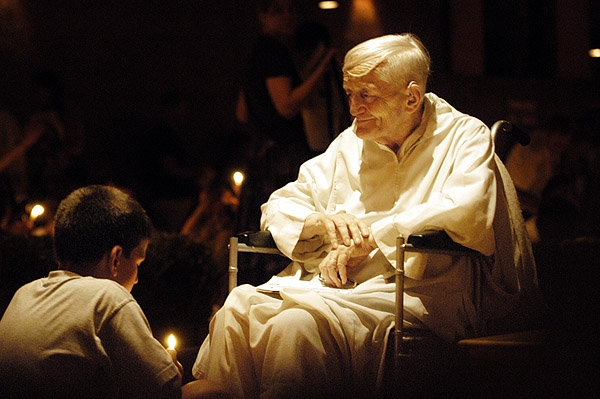 At the age of
90, Brother Roger was killed in August 2005 in a knife attack by a mentally ill
woman. Brother Roger's funeral was attended by several dignitaries including
the president of Germany and numerous religious leaders. The presider at his
funeral was a Catholic cardinal, Walter Kasper. The funeral was attended by approximately
10,000 people.
At the age of
90, Brother Roger was killed in August 2005 in a knife attack by a mentally ill
woman. Brother Roger's funeral was attended by several dignitaries including
the president of Germany and numerous religious leaders. The presider at his
funeral was a Catholic cardinal, Walter Kasper. The funeral was attended by approximately
10,000 people.
At the end of
2010, the community was composed of about one hundred brothers, from Protestant
and Catholic traditions, who originate from about thirty countries across the
world.The community is currently led by Brother Alois, a German-born
Catholic, who had been appointed by Brother Roger before his death.In the 1960s
young people began to visit the Taizé community. The first international young
adults meeting was organized in Taizé in 1966 with 1400 participants from 30
countries
The village
church of Taizé, which had been used for the community's prayers, became too
small to accommodate the pilgrims.[citation needed] A new church, the Church of
Reconciliation, was built in the early 1960s with the help of volunteers, and
expanded several times in the subsequent decades, first with tents, and then
with simple wooden annexes.In 1970, in
response to student protests taking place all over Europe and the world, as
well as the Second Vatican Council, Brother Roger announced a "Council of
Youth",.whose main meeting took place in 1974.At the end of
the 1970s, the meetings and surrounding activities began to be referred
to as a "Pilgrimage of Trust on Earth". The community decided
to focus on youth.The community, though Western European in origin, has sought
to include people and traditions worldwide. They have sought to demonstrate
this in the music and prayers where songs are sung in many languages, and have
included chants and icons from the Eastern Orthodox tradition. The music
emphasizes simple phrases, usually lines from Psalms or other pieces of
Scripture, repeated and sometimes also sung in canon. Earlier Taizé community
music was conceived and composed by Jacques Berthier.Later Joseph Gelineau
became a major contributor to the music.
Ecumenical
services based on this model and music are held in many churches throughout the
world.Throughout the year, meetings for young adults between 17 and 30 years
old (and, within certain limits, for adults and families with children) take
place in Taizé. The number of visitors reaches more than 5000 during the summer
and on Easterthough it is also possible to just come for a few days, or, for
young volunteers, to stay for a longer time.Several sisters
also help with running the meetings. However, they are not "Taizé
Sisters". These sisters come from various orders, most notably the
Catholic order of St. Andrew from Belgium. The Sisters of St. Andrew live in
the neighboring village Ameugny.Introduction to
the day with a brother of the community followed by quiet reflection or small
group discussion.The evening prayer is broadcast every Saturday The Taizé
Community attempts to send pilgrims back from youth meetings to their local
churches, to their parishes, groups or communities, to undertake, with many
others, a “Pilgrimage of Trust on Earth.”.Every year around New Year (usually
from 28 December to 1 January), a meeting in a large European city attracts
several tens of thousands of young adults. It is organized by brothers of the
Taizé Community, sisters of St. Andrew, and young volunteers from all over
Europe, and from the host city.The participants stay with local families or in
very simple group accommodations. In the morning, they take part in a program
organized by the parish closest to their accommodation. For their midday meal,
all participants travel to a central location, usually the local exhibition
halls. The meal is followed by a common prayer, and the afternoon is spent in
workshops covering faith, art, politics and social topics. In the evening,
everyone meets again for the evening meal and an evening prayer.
 |
Dr.Abraham Karikam and family visited
Taizé community on 9th June to15th june,2014
|
2. They want to learn ways of simple living ( brothers of the Community don't accept any donation for their sustenance. They have their own income generating projects like farming, book stall, pottery etc.) . They don't bring even their inheritance. In the midst of plenty, they show example of Very simple living.3. The prayer in the chapel of reconciliation (three times a day) is an exciting experience. (There are no sermons). The songs and chantings go deep into our hearts.4. They subscribe to the vision of Br. Roger - build a world without war and misery; accept every one as a child of God.
_______________________________________________________________________________


No comments:
Post a Comment