POLONNARUWA-
THE ANCIENT CITY OF SRI LANKA
 Polonnaruwa
was the second capital of Sri Lanka after the destruction of Anuradhapura in
993. It comprises, besides the Brahmanic monuments built by the Cholas, the
monumental ruins of the fabulous garden-city created by Parakramabahu I in the
12th century.Polonnaruwa bears witness to several civilizations, notably that
of the conquering Cholas, disciples of Brahminism, and that of the Sinhalese
sovereigns during the 12th and 13th centuries. This immense capital created by
the megalomaniac sovereign, Parakramabahu I, in the 12th century, is one of
history's most astonishing urban creations, both because of its unusual
dimensions and because of the very special relationship of its buildings with
the natural setting. It is also a shrine of Buddhism and of Sinhalese history.
The tooth of the Lord Buddha, a remarkable relic placed in the Atadage under
Vijabayahu, was considered as the talisman of the Sinhalese monarchy: its
removal by Bhuvanaikabahu II confirmed the decline of Polonnaruwa.
Polonnaruwa
was the second capital of Sri Lanka after the destruction of Anuradhapura in
993. It comprises, besides the Brahmanic monuments built by the Cholas, the
monumental ruins of the fabulous garden-city created by Parakramabahu I in the
12th century.Polonnaruwa bears witness to several civilizations, notably that
of the conquering Cholas, disciples of Brahminism, and that of the Sinhalese
sovereigns during the 12th and 13th centuries. This immense capital created by
the megalomaniac sovereign, Parakramabahu I, in the 12th century, is one of
history's most astonishing urban creations, both because of its unusual
dimensions and because of the very special relationship of its buildings with
the natural setting. It is also a shrine of Buddhism and of Sinhalese history.
The tooth of the Lord Buddha, a remarkable relic placed in the Atadage under
Vijabayahu, was considered as the talisman of the Sinhalese monarchy: its
removal by Bhuvanaikabahu II confirmed the decline of Polonnaruwa.
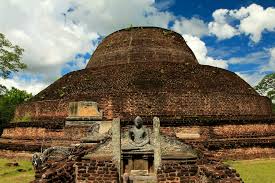
After the
destruction of Anuradhapura in 993 by Rajaraja, Polonnaruwa, a temporary royal
residence during the 8th century, became the capital. The conquering Cholas
constructed monuments to their religion (Brahmnism), and especially temples to
Shiva where fine bronze statues, today in the Museum of Colombo, were found.
The reconquest of Ceylon by Vijayabahu I did not put an end to the city's role
as capital: it became covered, after 1070, with Buddhist sanctuaries, of which
the Atadage (Temple of the Tooth Relic) is the most renowned.
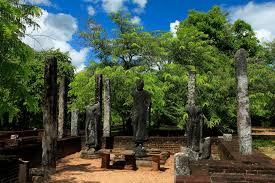

The
apogee of Polonnaruwa occurred in the 12th century AD. Two sovereigns then
proceeded to endow it with monuments. Parakramabahu I (1153-86) created within
a triple-walled enceinte a fabulous garden-city, where palaces and sanctuaries
prolonged the enchantment of the countryside. The following monuments date from
this reign: the Lankatilaka, an enormous brick structure which has preserved a
colossal image of Buddha; the Gal Vihara, with its gigantic rock sculptures
which may be placed among the chefs-d'œuvre of Sinhalese art; the Tivanka
Pilimage, where wall paintings of the 13th century illustrate the jataka(narratives
of the previous lives of Buddha), etc. Nissamkamalla hastily constructed
monuments that, although less refined than those of Parakramabahu I, were
nonetheless splendid: the Rankot Vihara, an enormous stupa 175 m in
diameter and 55 m high, is one of the most impressive; its plan and its
dimensions are reminiscent of the dagabas at Anuradhapura.
After
this golden age, Polonnaruwa underwent a century of difficulties, before its
final decline. The city which was invaded by the Tamils and the Maghas, then
reconquered in a precarious manner, was only periodically the capital before
the end of the 13th century when it was captured in an assault by
Bhuvanaikabuha II, who set up his government at Kurunegala.
Prof. John Kurakar


No comments:
Post a Comment